
Hyperliquid market making for Monero: how anyone can quote HXMR/USDC
The HXMR/USDC order book on Hyperliquid is open to every account. What a market maker needs, how the money flows between USDC, HXMR and XMR, what earns and what costs, and how to start with a bot.
 Wagyu teamPublished 11 min read

- total volume through Wagyu
- $1.5B+
- orders completed
- 84,600+
- account needed to swap
- 0
Anyone with a Hyperliquid account can make a market in Monero. Hyperliquid market making on HXMR/USDC means quoting both sides of the order book for HXMR, the token that the Wagyu bridge redeems 1:1 for XMR. You do not need Wagyu's permission to quote: the book is public and open to every Hyperliquid account. You only use Wagyu to move inventory between XMR and HXMR and, if you want, to have the bridge withdrawal fee waived for your address. Every order is screened for sanctions and illicit funds before it executes.
Key takeaways
- HXMR/USDC is spot market 1193 on Hyperliquid. The Wagyu app shows the same order book as XMR/USDC.
- Your bids pay USDC and fill with HXMR. Your asks sell HXMR for USDC.
- The bridge is your exit: redeem surplus HXMR to XMR, or bridge XMR in to refill your asks.
- Bridging in has no fee today. Bridging out costs a withdrawal fee unless Wagyu waives it for your address.
- Quote around the XMR price, post only, and hedge or keep your inventory small.
What Hyperliquid market making on HXMR means
A market maker keeps a buy order (a bid) below the current price and a sell order (an ask) above it. When other traders hit those orders, the market maker earns the gap between the two prices, the spread. The book is busier and tighter for everyone else.
On Hyperliquid, HXMR trades against USDC on the spot order book, as spot market 1193. HXMR is the Monero token issued through the Wagyu bridge, and it can be bridged back to native XMR. That is what makes a two-sided market possible: whatever inventory you build up on one side, you can settle in real Monero. The guide XMR on Hyperliquid explains HXMR itself, and the market making page of the Wagyu docs is the reference for everything below.
On Hyperliquid
You quote HXMR/USDC from your own account, like any trader. No listing, no application.
On Wagyu
You bridge XMR in and out, and you can ask for the market maker fee waiver.
How the money flows between USDC, HXMR and XMR
USDC and HXMR trade on Hyperliquid. HXMR and XMR move through the Wagyu bridge. Each HXMR is backed 1:1 by XMR in Wagyu's reserve, so a one-sided book can always be turned back into Monero while the bridge is open.
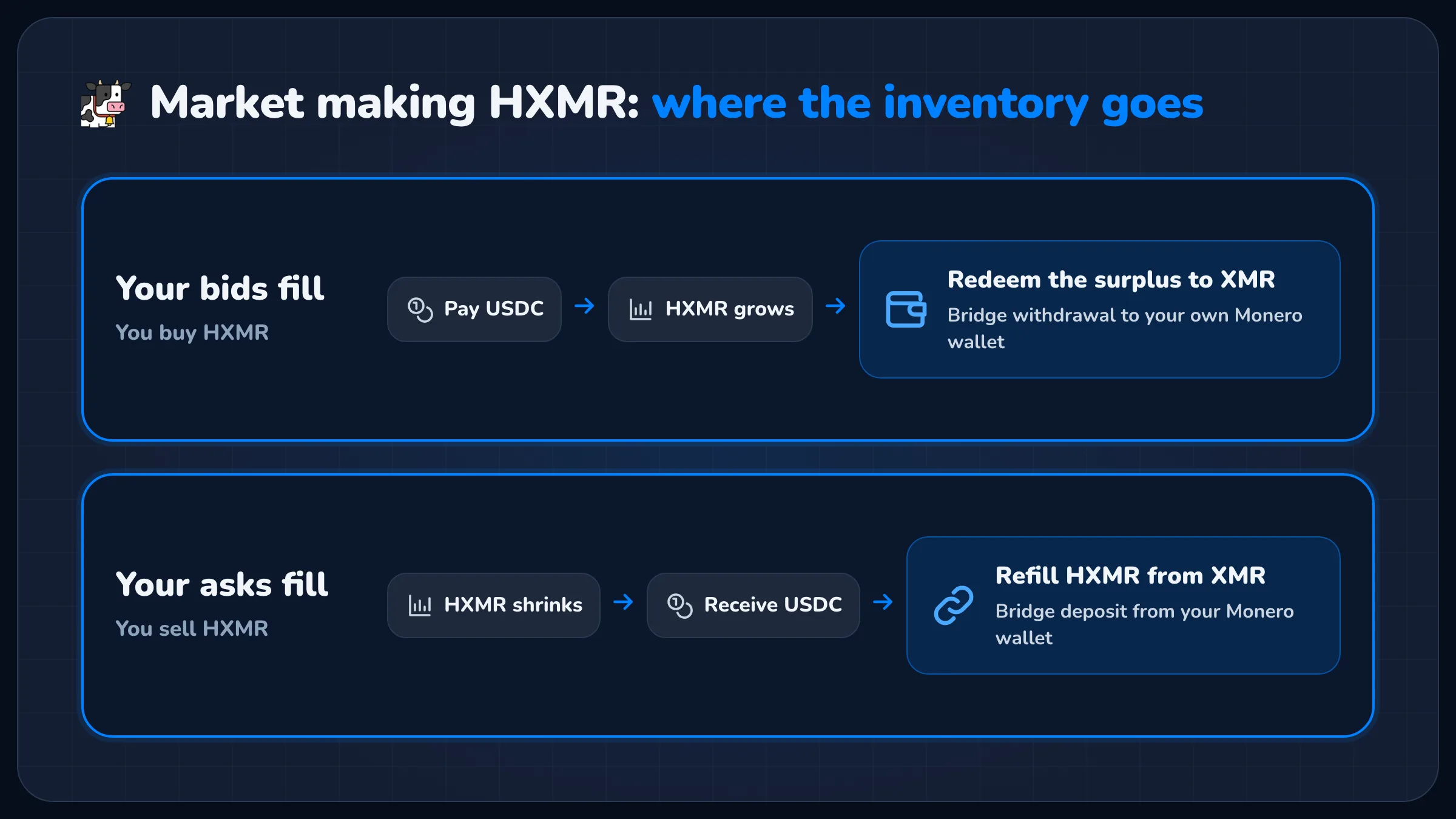
- Your bids fill: you pay USDC and accumulate HXMR. Redeem the surplus to XMR with a bridge withdrawal.
- Your asks fill: you receive USDC and run out of HXMR. Refill it from XMR with a bridge deposit.
How fills arrive
Fills come in bursts: one large order can take several levels of your quotes in a second. They are also often one-sided for a while. On a day when XMR is falling, most fills can be sales to you, so your USDC shrinks and your HXMR grows until buyers return or you redeem through the bridge. Bring enough USDC for that, and decide in advance what your bot does when it runs out.
The arbitrage band
The bridge fees set a band around the XMR price. If HXMR trades above XMR, you can buy XMR, bridge it in and sell the HXMR. If HXMR trades below XMR, you can buy HXMR, withdraw it and sell the XMR, but without a fee waiver that only pays once the discount is larger than the withdrawal fee. With a waiver, that side of the band closes to your trading costs and the bridge delay.
What you need to start
| Feature | Why |
|---|---|
| A Hyperliquid account with USDC | Your bids are paid in USDC. |
| Its private key in a local .env file | It signs your bot's orders. Use a fresh account that holds only the bot's funds. |
| XMR, HXMR or both | Inventory for the ask side. Bridge XMR in to get HXMR. |
| A Monero wallet you control | It receives XMR when you redeem HXMR. |
| An XMR price | Your fair value: the Hyperliquid XMR perp, or an exchange you trust. |
| A bot | A starter loop or the full hedged bot spec in the Wagyu docs. |
Quote around the XMR price, not around the HXMR book: HXMR tracks XMR, and the XMR perpetual on Hyperliquid is liquid and on the same venue. The bridge minimum is 0.005 XMR per order. Monero wallets are on the official Monero site.
Hyperliquid market making economics: what earns and what costs
Nobody can tell you your profit in advance: it depends on your spread, your volume, the XMR price and how often you rebalance. These are the pieces that make it up. Hyperliquid's trading fees are in its fee schedule.
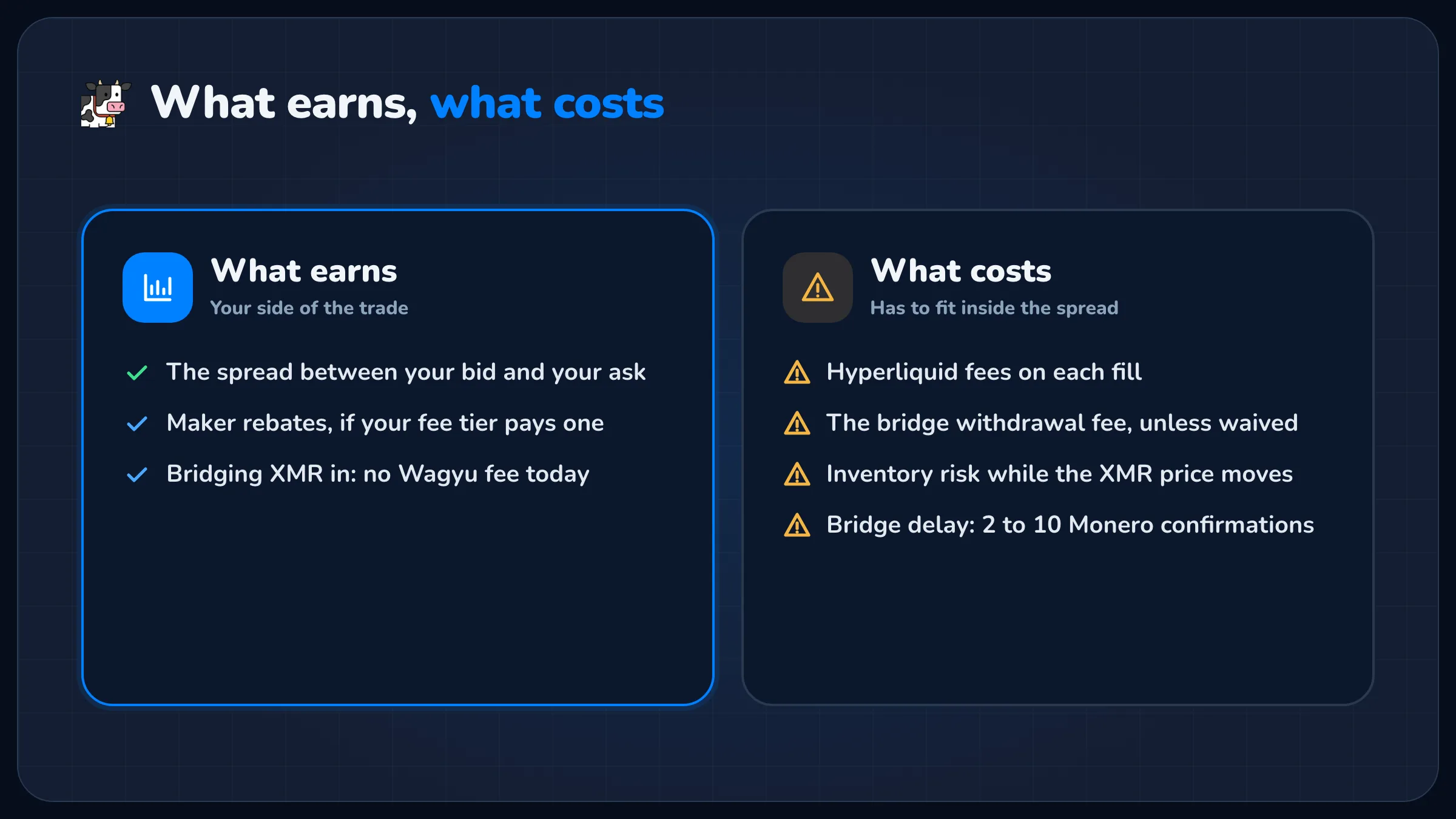
| Feature | Effect | How to manage it |
|---|---|---|
| Spread captured | Income: the gap between where you buy and where you sell HXMR. | Quote inside the current spread to get fills, wide enough to cover the costs below. |
| Hyperliquid fees | A cost or a rebate per fill, from Hyperliquid's fee schedule. Maker fees are lower and fall with your 14-day volume. | Post only, so every fill pays the maker rate. |
| Bridge deposit, XMR to HXMR | Wagyu's fee is 0%, plus the Monero network fee to send it. | Refill the ask side freely. |
| Bridge withdrawal, HXMR to XMR | Wagyu's fee is 2%, unless you have a market maker waiver. | Ask for the waiver before you redeem in size. |
| Inventory risk | Gain or loss on the XMR you hold while the price moves. | Hedge it on the XMR perp, or keep inventory small. |
| Bridge delay | A deposit is credited after 2 to 10 Monero confirmations. Redeemed XMR is spendable 10 blocks after it lands. | Keep a buffer of both assets so a fill never waits for the bridge. |
Right now the bridge charges 0% to bridge XMR in and 2% to redeem HXMR, with a 0.005 XMR minimum each way. The bridge page and the native bridge docs always show the live terms.
The bridge fee waiver for market makers
Wagyu can waive or reduce the bridge withdrawal fee for the Hyperliquid addresses a market maker sends HXMR from. Message Wagyu support with two things:
- the Hyperliquid address, or addresses, your HXMR withdrawals will be sent from;
- roughly how much you expect to quote and redeem.
A waiver belongs to one sending address. Send all the HXMR for a withdrawal order from that one address: if two addresses fund the same order, no waiver applies and the order pays the standard fee. Before you send, ask the bridge for a quote with your address as the sender and read the fee it returns. The fee actually charged is computed from the address the HXMR really came from.
One hedged fill, start to finish
Here is what a hedged bot does with a single trade, using the example from the Wagyu bot spec. XMR is at $450.00 and the bot quotes 1% each side. The numbers are an illustration, not a forecast.
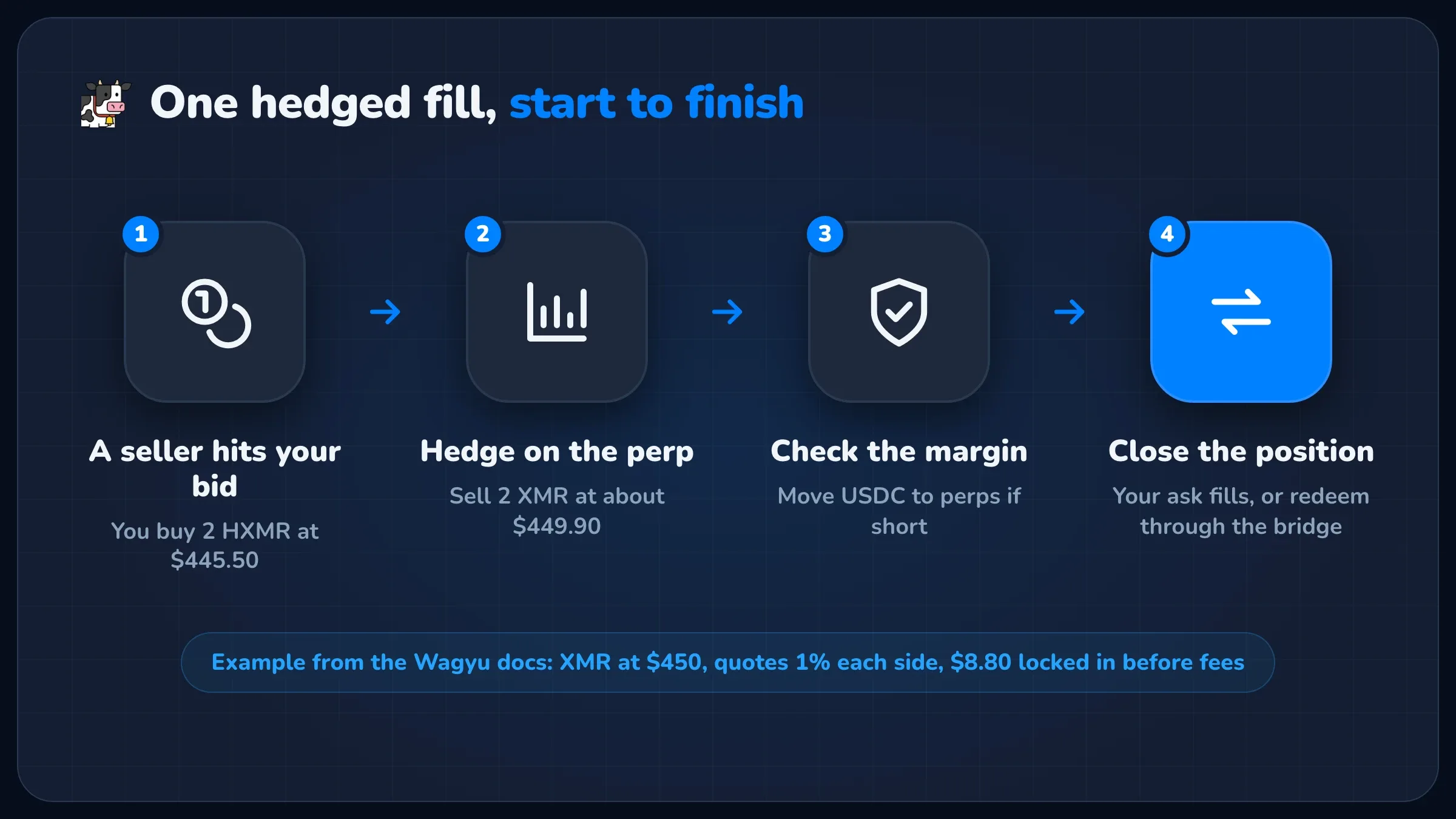
1. A seller hits your bid
You buy 2 HXMR at $445.50 and pay $891.00 of spot USDC. You now hold 2 XMR more price exposure than you want.
2. The bot hedges on the perp
It sells 2 XMR on the XMR perpetual at about $449.90. The price risk is gone and $8.80 is locked in, before fees.
3. It checks the margin
A 2 XMR short at 2x needs about $450 of margin, plus a buffer for price moves. If the perp balance is short, the bot moves USDC from spot to perps.
4. The position closes
A buyer lifts your ask at $454.50 and the bot buys back the perp: you earned both sides. Or you redeem the HXMR through the bridge and close the perp.
The last step is where the waiver matters. Redeeming the 2 HXMR without a waiver costs the 2% withdrawal fee. At 2%, that is about $18 here, more than the $8.80 the trade earned. With a waiver, the bot keeps it.
Run a Hyperliquid market making bot for HXMR
The Wagyu docs give two starting points. A [minimal quoting loop](docs:/market-making) in Python, built on Hyperliquid's official Python SDK, places one post-only bid and one post-only ask around the XMR perp price and requotes only when that price moves. It is a sketch: it does not hedge or look at your balances. The [full hedged bot spec](docs:/market-making-bot) describes a complete bot, and comes with a prompt you can paste into Claude Code or another coding agent so it builds the bot from the spec, in dry-run mode first.
Quoter
Post-only quotes on HXMR/USDC, sent in batches, skewed to keep inventory near its target.
Hedger
Keeps the bot's net XMR exposure near zero with the XMR perp.
Treasurer
Every 30 to 60 seconds, moves USDC between spot and perps and sends surplus HXMR to the bridge.
Risk manager
Limits, a watchdog and a kill switch that pulls every quote when something is stale.
Hyperliquid order rules for HXMR
| Feature | Value |
|---|---|
| Coin name in the info and WebSocket APIs | The spot index 1193, preceded by an at sign |
| Asset ID for orders | 11193 (10000 plus the spot market index) |
| Smallest size | 0.00001 HXMR (5 size decimals) |
| Price | At most 5 significant figures and 3 decimals |
| Minimum order value | 10 USDC |
| Post-only | Time in force Alo: cancelled instead of taking liquidity |
Hyperliquid's own rules are in its docs: asset IDs, tick and lot size and rate limits. Read the token's identity from Hyperliquid's spot metadata at start-up rather than trusting a copied constant, and read the bridge fees and minimums from the bridge API rather than hard-coding them. The API reference and the native bridge docs describe the bridge endpoints; no key is needed to create a bridge order.
Set up a market making account
1. Connect a fresh wallet in the Wagyu app
Open the Wagyu app and connect the wallet. This is the bot's account. Use one that holds only the bot's funds, since its key will be on a server.
2. Deposit USDC
With the app's deposit flow.
3. Bridge XMR to HXMR
With the Wagyu bridge. HXMR arrives after 2 to 10 Monero confirmations.
4. Use standard account mode
Turn Unified Account off. Hyperliquid recommends standard mode for market makers, and unified mode caps actions per day.
5. Split USDC between spot and perps
Spot USDC pays for bids, perp USDC is the hedge margin.
6. Ask for the fee waiver
For the bot account's address, if you will redeem HXMR.
Your open orders, positions and balances show in the Wagyu app like any manual trade, and you can cancel from there in an emergency.
Risks to understand
- Real money from the first test. Hyperliquid's testnet has no HXMR market. Run a bot in dry-run mode first, then with small sizes.
- One-sided fills. A falling market can turn most of your USDC into HXMR. Keep the asks on the book: they are how USDC comes back.
- Inventory risk. Unhedged HXMR moves with the XMR price.
- Paused bridge directions. Check the bridge before each order. A direction that is switched off refuses new orders: skip it rather than retry.
- Public activity. Your Hyperliquid address, balances and trades are visible to anyone.
- Screening. Every order is screened for sanctions and illicit funds before it executes, bridge orders included. A deposit that fails screening is refunded, except where the compliance policy requires Wagyu to block it.
This article explains how the pieces work. It is not financial advice and does not promise any profit.
Need HXMR to quote the ask side?
Bridge XMR to HXMRFAQ about Hyperliquid market making for Monero
Can anyone become a market maker for HXMR?
Yes. The HXMR/USDC book on Hyperliquid is public and open to every Hyperliquid account. You do not need Wagyu's permission to quote; you only talk to Wagyu to bridge inventory and, if you want it, to get the withdrawal fee waived.
Is HXMR/USDC the same market as XMR/USDC in the Wagyu app?
Yes. The Wagyu app shows HXMR/USDC as XMR/USDC. On Hyperliquid it is spot market 1193. It is not the XMR-USDC perpetual, which settles in USDC and never pays out Monero.
How does a market maker earn money on HXMR?
By capturing the spread: buying HXMR on the bid and selling it on the ask. Hyperliquid fees, the bridge withdrawal fee without a waiver and price moves on the inventory all come out of that spread.
What does the market maker fee waiver cover?
The bridge withdrawal fee, HXMR to XMR, for the Hyperliquid address you send HXMR from. It belongs to one sending address, and an order funded from two addresses pays the standard fee.
Do I need to hedge?
Not to start, but unhedged inventory carries the XMR price risk. The full bot spec in the Wagyu docs hedges with the XMR perpetual on Hyperliquid so the bot earns the spread without betting on the Monero price.
Can I test on Hyperliquid's testnet?
No. Hyperliquid's testnet has no HXMR market, so the first real test is on mainnet with a small amount, after a dry run.
Where do I get HXMR for the ask side?
Bridge XMR in with the Wagyu bridge, or buy HXMR on the book with USDC. If you hold another coin, swap it to XMR first, for example BTC to XMR.
Can an AI agent build the bot for me?
The bot spec in the Wagyu docs includes a prompt to paste into Claude Code or another coding agent, so it builds the hedged bot from the spec in dry-run mode. Create the .env file with the private key yourself and never paste the key into the chat.

Written by the Wagyu team
Wagyu offers swaps between Monero and supported networks, plus a native Monero bridge to Hyperliquid.