
No KYC crypto swap: what it means, what you still share, and how to check a service
No KYC means no account and no identity check. It does not mean no rules: minimums, deadlines and screening still apply, and a lookalike site can take your coins. What to know before your first swap.
 Wagyu teamUpdated 6 min read
- total volume through Wagyu
- $1.3B+
- orders completed
- 35,700+
- account needed to swap
- 0
- SOL to XMR swap time
- 1 min
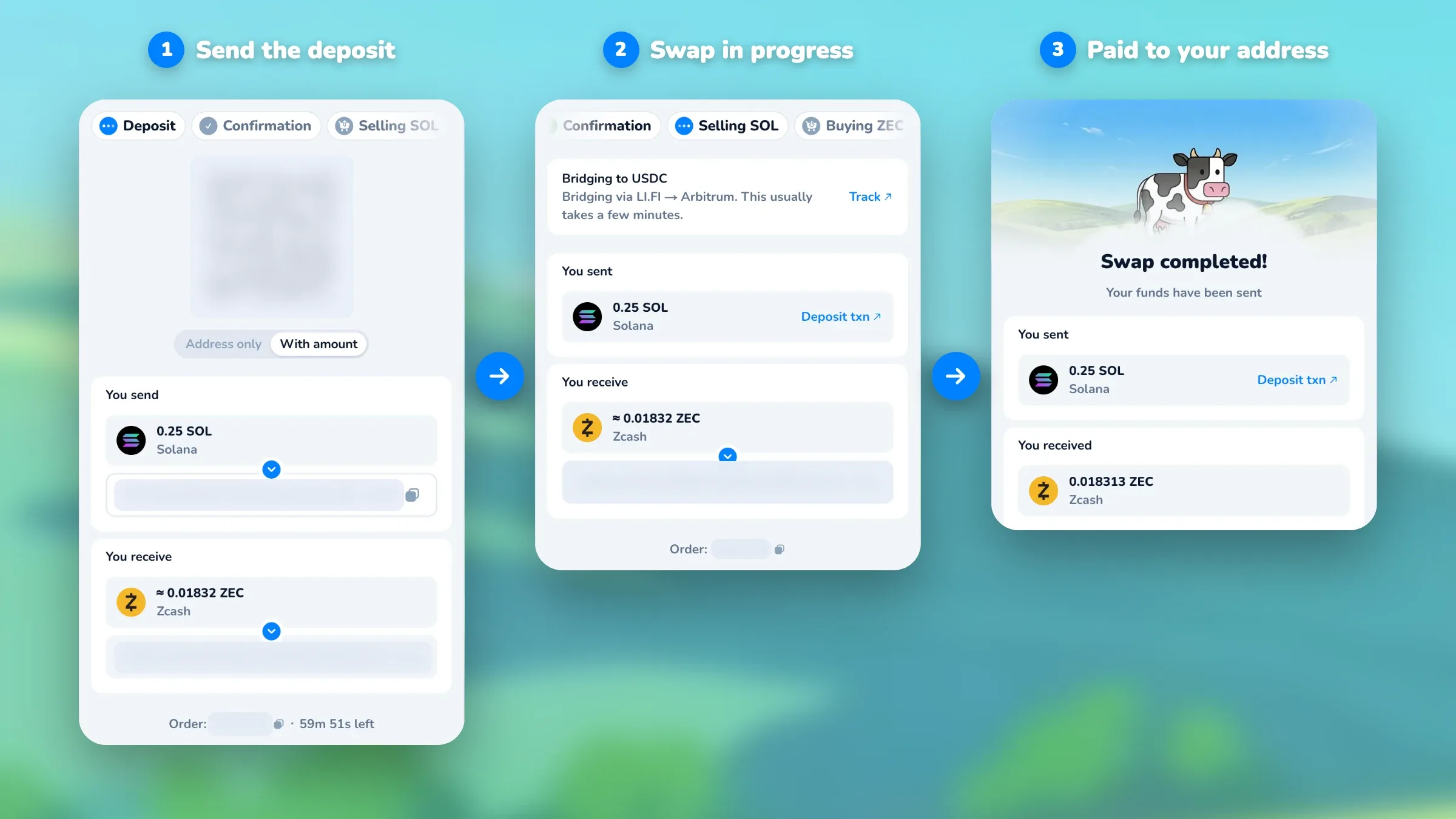
A no KYC crypto swap trades one coin for another without an account and without an identity check. You choose the two coins, paste the address where you want to be paid, send your coins to a one-time deposit address, and receive the other coin in your own wallet. On Wagyu that works between Bitcoin, Monero, Ethereum, Solana, USDT, USDC and Zcash, on the swap routes the site lists. No KYC does not mean no rules, so here is what you still share, the limits that apply, and how to check a service before you send anything.
Key takeaways
- No KYC: no account, no ID, no selfie. You only give a payout address.
- Minimums, the funding deadline and the network you send on still apply.
- Some orders are screened under the service's compliance policy.
- Most losses come from lookalike sites and wrong networks, not from the swap itself.
What a no KYC crypto swap means
KYC, short for know your customer, is the identity check that exchanges run when you open an account: a name, an ID document, often a selfie and a proof of address. A no KYC swap skips the account entirely. There is nothing to sign up for and nothing to verify, because there is no balance to keep: each swap is a single order that ends when your coins arrive.
| Feature | Exchange account | No KYC swap |
|---|---|---|
| Account | Required | None |
| Identity check | ID document, often a selfie | None |
| Where your coins wait | In the exchange account | In your own wallet |
| Pay with cash or a card | Often possible | Not possible |
| Coins available | Depends on the exchange and your country | The routes the service lists |
The last two rows matter. A swap starts from crypto you already hold: Wagyu does not sell crypto for cash or by card. If you start from fiat, you buy a supported coin elsewhere first, then swap it.
What you still share in a no KYC swap
No identity does not mean no information. To run your order, the service needs the coins you send, the amount, and the address where it pays you. Wagyu never asks for your name, email or phone number, an ID document, a selfie or a proof of address.
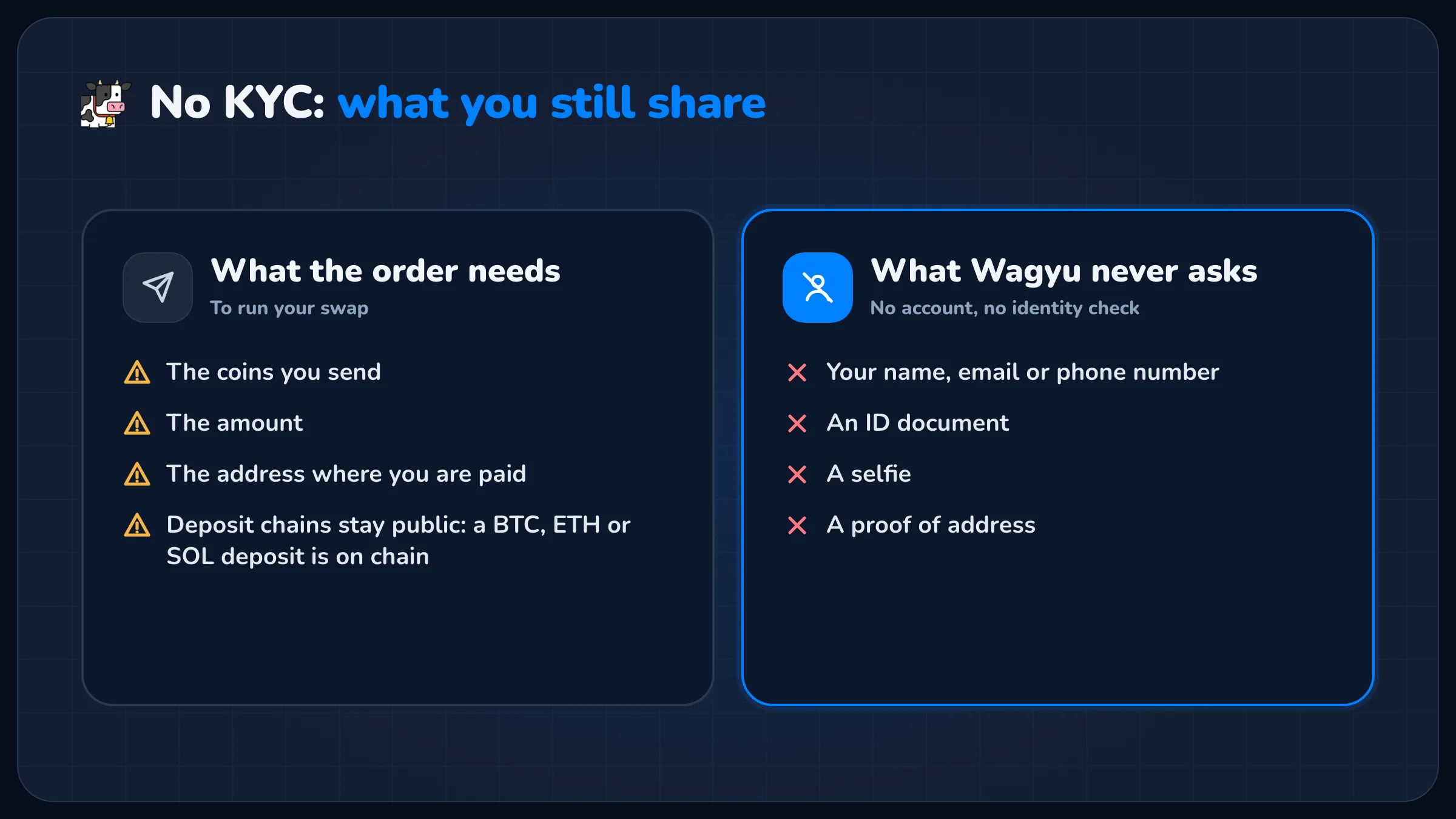
The blockchains also keep their own records. A Bitcoin, Ethereum or Solana deposit is public on its chain like any payment. A Monero payout hides the receiver and the amount on chain, which is why many people swap into XMR. The guide is Monero traceable explains what that does and does not hide.
The limits that still apply
Skipping the account does not remove the rules of the order. Four of them decide whether a swap goes smoothly.
Minimums
Each route has a smallest amount it accepts. BTC to XMR: $40. ETH to XMR: $20. Check the swap page before you send.
A funding deadline
Each order shows a deadline to send your deposit. Send before it, in one transfer if you can.
The right network
USDT and USDC exist on several chains. Send on the network the order shows, or the deposit cannot be matched to it.
Screening
Some orders are screened. The rules are in the compliance policy linked below.
Wagyu publishes its rules in the compliance policy. Read it before you swap: it is the document that applies to your order, and it is more precise than any summary.
If a deposit is short, late or on the wrong network
Most problems with a swap come from the deposit, not the trade. The order lifecycle page describes each case. In short:
- Too little sent, in a token. You can top up the same deposit address until the funding deadline. After that, the order continues on what arrived. If what arrived is too small to swap, the order expires and support returns it.
- Too little sent, in XMR or ZEC. If the deposit is under the order minimum, send the rest to the same address. A small deposit that confirms on its own under the minimum is set aside and support returns it.
- Too much sent. The order executes on everything that arrived; the extra is swapped, not refunded.
- Sent after the deadline. The order expires, but the address stays watched and support recovers a late deposit.
- Sent on the wrong chain. The order page asks for a refund address. Once you submit it, the refund starts after the service's checks.
How to check a no KYC swap service before you send
Without an account, there is nobody to call at a bank. The checks you do before sending are your protection. They take a few minutes.
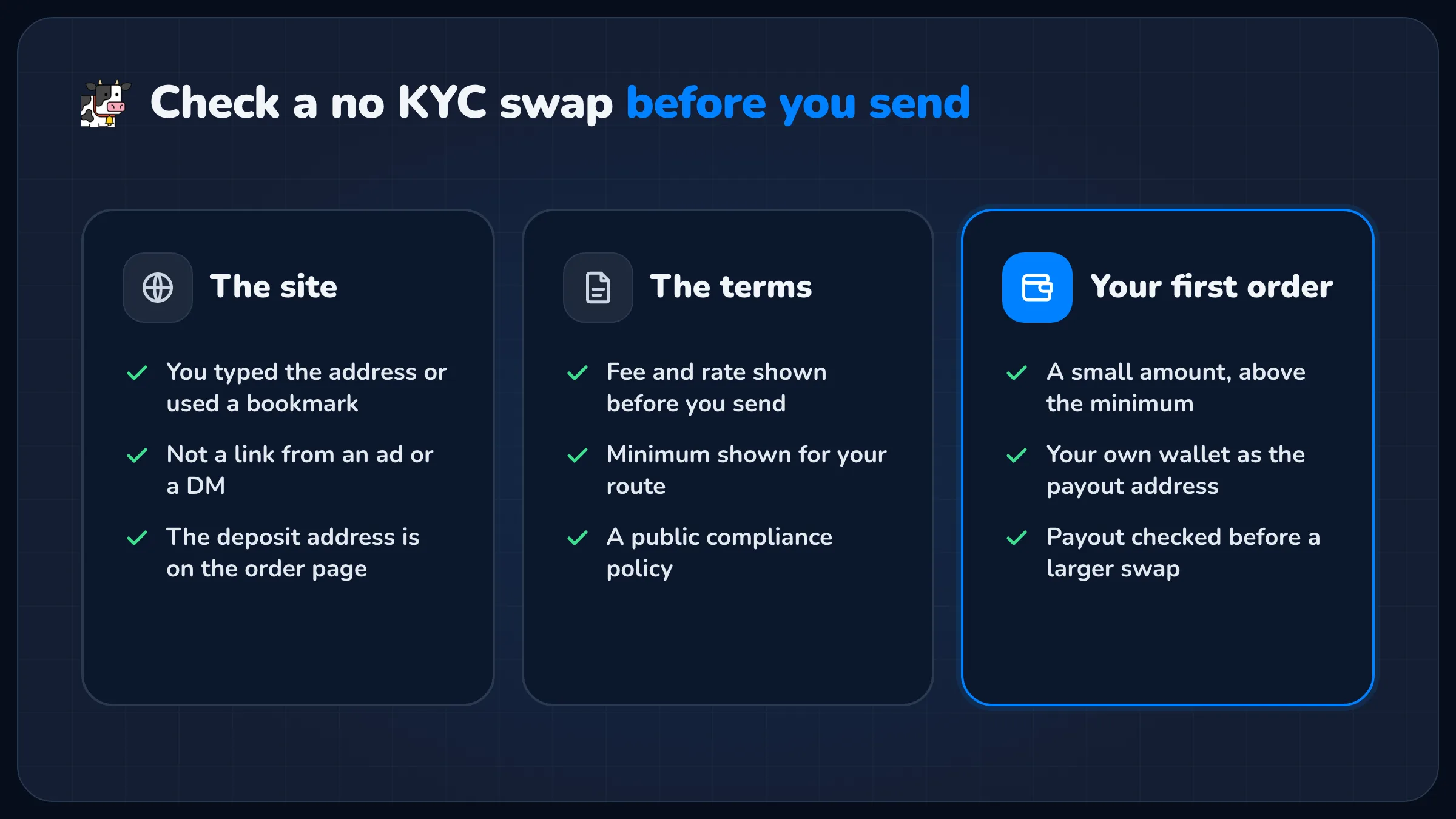
The site
- You typed the address or used a bookmark
- Not a link from an ad, a DM or a search result you did not check
- The deposit address is shown on the order page itself
The terms
- Fee and rate shown before you send
- Minimum shown for your route
- A public compliance policy
- Documentation of what happens to a short or late deposit
Your first order
- A small amount, above the minimum
- Your own wallet as the payout address
- The payout checked in your wallet before a larger swap
Lookalike sites copy the design of real swap services and replace the deposit address. Copies of Wagyu on other domains swap the deposit address for their own, so check the address bar before you send. If a page asks for your seed phrase, a wallet connection to claim a reward, or a deposit on a page that is not your order, close it.
No KYC swap routes on Wagyu
The table shows live fees, minimums and typical times for common routes. Each row opens the swap page, where you get the exact quote for your amount.
| Route | Default network | Minimum | Typical time | Fee | Route |
|---|---|---|---|---|---|
| BTC to XMR | Bitcoin | About $40 | About 30 min | 2% | BTC to XMR |
| ETH to XMR | Ethereum | About $20 | About 2 min | 2% | ETH to XMR |
| SOL to XMR | Solana | About $20 | About 1 min | 2% | SOL to XMR |
| USDC to XMR | Arbitrum | About $20 | Under 1 min | 2% | USDC to XMR |
| XMR to BTC | Monero | About $25 | About 25 min | 0% | XMR to BTC |
| XMR to USDT | Monero | About $25 | About 16 min | 0% | XMR to USDT |
| BTC to ZEC | Bitcoin | About $40 | About 20 min | 2% | BTC to ZEC |
| ZEC to XMR | Zcash | About $20 | About 10 min | 2% | ZEC to XMR |



To buy XMR, the guide how to buy Monero without KYC compares each route in detail. For Zcash, read how to buy Zcash without KYC. If you want XMR on Hyperliquid, the Monero bridge moves XMR to XMR1 and back.
Try a small swap first.
Swap ETH to XMRFAQ about no KYC crypto swaps
What is a no KYC crypto swap?
A trade of one coin for another without an account or an identity check. You send coins to a one-time deposit address and receive the other coin at your own address.
Is a no KYC swap legal?
That depends on where you live and what you do with it. Using a swap does not replace your own obligations, such as taxes. Wagyu's rules are in its compliance policy.
Do I need an account on Wagyu?
No. There is no sign-up and no identity check. You only give the address where you want to be paid.
Can I buy crypto with a card without KYC on Wagyu?
No. Wagyu only swaps crypto you already hold. If you start from fiat, buy a supported coin elsewhere first, then swap it.
What is the minimum for a no KYC swap?
It depends on the route. For example, BTC to XMR accepts $40 or more, and ETH to XMR $20 or more. Each swap page shows the live minimum.
What happens if I send less than I said?
For tokens, you can top up the same address until the funding deadline, then the order continues on what arrived, or expires and support returns it if that is too small. For XMR or ZEC under the order minimum, send the rest to the same address. The order lifecycle page has the details.

Written by the Wagyu team
Wagyu offers swaps between Monero, Zcash and supported networks, plus a native Monero bridge to Hyperliquid.